



Under Eye Fillers for Hollow Eyes, Tear Trough & Dark Circles
Medically Reviewed by Dr. Shobha Sanghvi, M.B.B.S., DCP | Cosmetologist & Laser Aesthetic Specialist
“Tired eyes can age a face faster than almost anything else.”
Hollow under eyes, persistent dark circles, and stubborn eye bags often remain even after a full night’s sleep, a healthy diet, and the best skincare routine money can buy. That’s because these concerns are usually structural, not just a matter of fatigue.
This is where under eye fillers comes in, offering a non-surgical way to restore volume, smooth shadows, and bring back a fresher, more rested look.
Good to know |
Table of content
Understanding hollow under eyes and the different types of eye bags
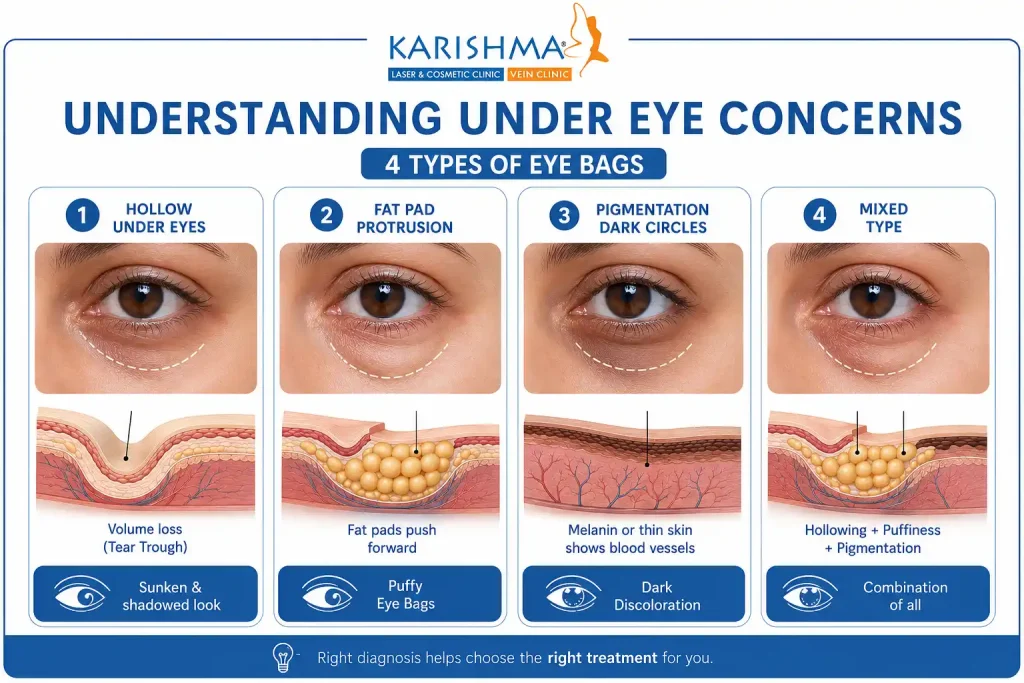
Not all under eye concerns are the same, and understanding the difference matters when choosing the right treatment.
- Hollow under eyes: caused by volume loss in the tear trough area, creating a sunken, shadowed appearance.
- Fat pad protrusion: often what people mean when they say “puffy eye bags”, caused by weakened muscle and fat bulging forward.
- Pigmentation-related dark circles: caused by excess melanin or thin skin that reveals underlying blood vessels.
- Mixed type: a combination of hollowing, mild puffiness, and pigmentation together.
Recognizing which of these types of eye bags applies to you helps determine whether under eye fillers alone will help, or whether it should be combined with other treatments.
What causes tear trough hollows and dark circles
The tear trough is the shallow groove that runs from the inner corner of the eye down toward the cheek. Several factors contribute to tear trough hollowing:
- Natural aging and loss of collagen and fat volume.
- Genetics, since some people are simply predisposed to a deeper tear trough from a young age.
- Sun exposure and lifestyle factors that thin the skin over time.
- Sleep deprivation and dehydration, which worsen the appearance of existing hollows.
- Allergies and chronic rubbing, which can darken the skin and prominent crow’s feet lines around the eyes.
Dark circles and tear trough hollows often appear together because the same thinning skin that reveals shadows also allows underlying blood vessels to show through, making the area look darker and more tired than it actually is.
How under eye filler works
Under eye filler is made from hyaluronic acid, a substance naturally found in the skin that attracts and retains moisture. When injected carefully into the tear trough, it:
- Restores lost volume to smooth the hollow, shadowed appearance.
- Blends the transition between the lower eyelid and the cheek.
- Softens the look of dark circles caused by shadowing.
- Provides a subtle lift that can also soften nearby crow’s feet.
A qualified injector will assess your anatomy, skin thickness, and the depth of the hollow before recommending the right technique and volume. This precision is what separates a natural, refreshed result from an overfilled or uneven one. It’s worth noting how mainstream this treatment has become closer to home too, India recorded nearly 1.3 million aesthetic procedures in 2024, with non-surgical injectables like hyaluronic acid fillers accounting for at least half of them, according to the International Society of Aesthetic Plastic Surgery (ISAPS). India in fact ranks among the top countries globally for non-surgical facial rejuvenation.
At Karishma Laser & Cosmetic Clinic, this precision-based technique is performed under the guidance of Dr. Shobha Sanghvi, ensuring the correct depth and volume for a natural, refreshed result.
The Procedure: What to Expect
Before the injection begins, a topical numbing cream is applied to the under-eye area and left on for about 35 to 40 minutes. This makes the treatment far more comfortable, and most fillers used today also contain lidocaine pre-mixed into the syringe for additional pain relief. Because of this, most patients describe the sensation as mild pressure rather than pain.
The consultation itself takes about 20 to 30 minutes, where your injector assesses your skin thickness, tear trough depth, and anatomy to plan the right technique and volume. The actual injection process is quick, usually taking 10 to 15 minutes. Including numbing time, most patients complete their visit within an hour to ninety minutes.
Curious if under eye filler is right for you? Book a consultation.
Fillers for dark circles versus other options
Fillers for dark circles work best when the shadow is caused by structural hollowing rather than pigmentation alone.
If discoloration is the main issue, filler is often combined with treatments that target pigment directly, such as topical brightening agents or light-based therapies.
A proper consultation helps determine whether tear trough filler alone will be enough, or whether a combination approach will give the most complete result.
Under eye filler before and after: what results can you expect?
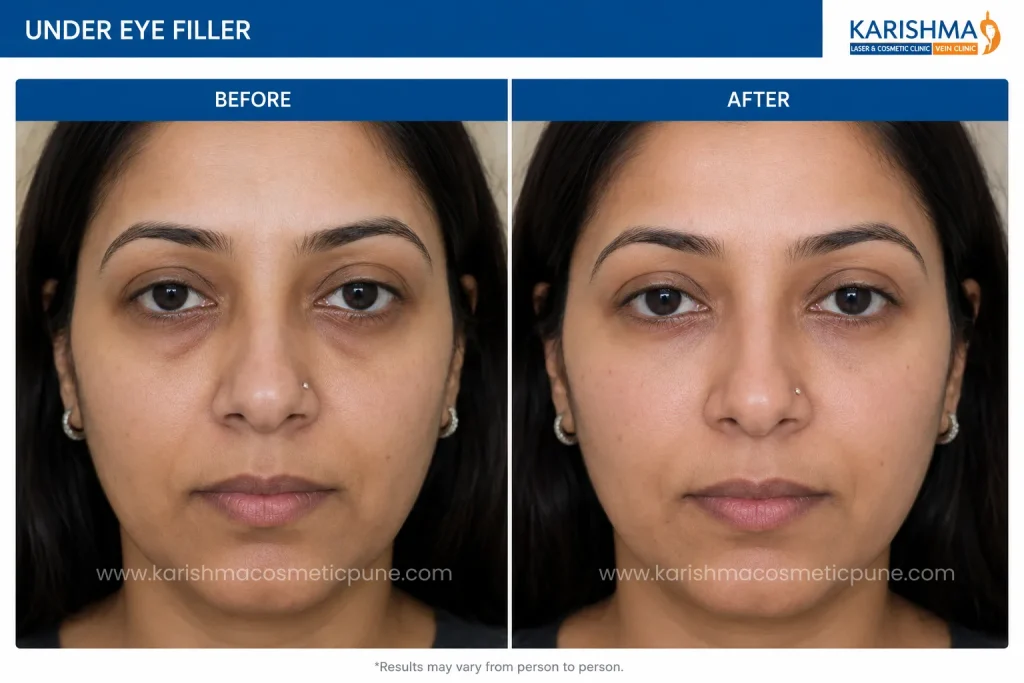
Most patients notice an immediate improvement in volume and shadowing right after treatment, with any minor swelling settling within a few days. In terms of under eye filler before and after results, people see:
- A smoother, less hollow appearance under the eyes.
- Reduced visibility of dark circles caused by shadowing.
- A more rested, refreshed look without an overdone appearance.
- Gradual settling of the filler over the following one to two weeks for the most natural final result.
Results vary depending on individual anatomy, skin quality, and the amount of volume loss being corrected, which is why a personalized consultation is essential before treatment.
How long do under eye fillers last?
A common question from first-time patients is: how long do under eye fillers last?
On average, tear trough filler lasts between nine months and eighteen months, though this varies based on the type of filler used, metabolism, and lifestyle factors.
Because the under eye area moves less than the cheeks or lips, results in this area often last longer than fillers placed elsewhere on the face.
Aftercare & Recovery: What to Avoid
The good part about under eye fillers is that there’s no real downtime – most people go straight back to their day. That said, the first week does need a bit of care to make sure the result settles evenly.
Right after the treatment, it’s best to leave the area alone – no rubbing, no pressing, no makeup for a few hours. Working out hard on the same day isn’t a great idea either; the extra blood flow tends to bring on more swelling or bruising than you’d otherwise get. Skipping alcohol for a day or two helps for the same reason.
Over the next few days, keep the area away from direct sun and avoid saunas or steam – heat can shift how the filler settles under the skin. It’s also worth holding off on facials or any peel-type treatment near the eyes until things have fully calmed down. Sleeping with your head slightly propped up for the first night or two helps bring swelling down faster too.
Some puffiness or light bruising in the first few days is completely normal and fades on its own within a week. If swelling doesn’t go down, or something feels off – unusual pain, warmth, anything that doesn’t seem right – that’s when you’d want to reach out to the clinic rather than wait it out.
Under eye filler cost: what influences the price
Under eye filler cost depends on several factors, including:
- The amount of product required to correct the hollow
- The experience and expertise of the injector
- The clinic’s location and facilities
- Whether the treatment is combined with other procedures
While cost is an important consideration, choosing an experienced, qualified practitioner should always take priority over price alone, since the tear trough is a delicate area where technique makes a significant difference to the final result
Under eye filler vs surgical blepharoplasty
Factor | Under eye filler | Surgical blepharoplasty |
Procedure type | Non-surgical injectable | Surgical procedure |
Downtime | Minimal, back to routine within days | One to two weeks recovery |
Best for | Volume loss, mild to moderate hollowing | Excess skin, significant fat pad protrusion |
Results duration | Nine to eighteen months | Long-lasting, often permanent |
Reversibility | Can be dissolved if needed | Permanent, not reversible |
Anesthesia | Topical numbing only | Local or general anesthesia |
This comparison highlights why many patients start with under eye filler as a lower-commitment option before considering surgery, especially when the primary concern is hollowing rather than excess skin.
Trust Karishma Laser & Cosmetic Clinic for expert tear trough filler care in Pune
Choosing the right hands for under eye filler makes all the difference between a natural, refreshed result and one that looks uneven or overdone.
With decades of combined experience under the guidance of Dr. Suresh Sanghvi and Dr. Shobha Sanghvi, patients receive a careful, individualized approach to treating hollow under eyes, dark circles, and tear trough concerns.
Ready to look as rested as you feel?
Dealing with facial asymmetry too? Check out our guide on Why Is One Side of My Face Fatter Than the Other Side.